

Stroke Emergency Care
Stroke symptoms come on suddenly and without pain, and they require an immediate 911 call rather than a drive to the hospital. Boulder City Hospital’s 24/7 Emergency Room at 901 Adams Boulevard is the closest emergency facility for Boulder City residents and sits minutes from Henderson communities including Cadence. Our team is trained to recognize stroke quickly, begin emergency evaluation, and coordinate the next level of care without delay.
Think someone is having a stroke? Call 911 now. Do not drive yourself or the patient. Paramedics can begin care on the way and alert our ER before you arrive. (702) 293-4111, 24 hours a day, 7 days a week 901 Adams Boulevard, Boulder City, NV 89005 | Get Directions → |
Warning Signs of a Stroke
Stroke warning signs appear suddenly, usually without pain, which is exactly why they get explained away or waited out. Learn them now so you can act in seconds later.
|
|
Symptoms that go away on their own are still an emergency. A transient ischemic attack (TIA), often called a warning stroke, is caused by a temporary blockage and signals a high risk of a full stroke soon after.
Stroke Warning Signs in Detail
B.E. F.A.S.T., the six signs worth memorizing
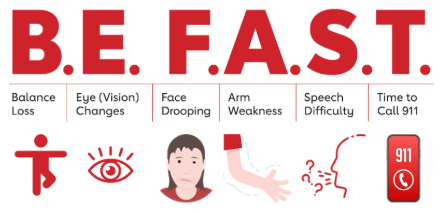
The American Stroke Association uses the letters B-E-F-A-S-T to make stroke signs easy to recall under pressure.
- B is for Balance. Sudden loss of balance, dizziness, or difficulty walking.
- E is for Eyes. Sudden trouble seeing in one or both eyes, including blurred or double vision.
- F is for Face. Ask the person to smile. Does one side of the face droop?
- A is for Arms. Ask the person to raise both arms. Does one drift downward?
- S is for Speech. Ask them to repeat a simple sentence. Is speech slurred or strange?
- T is for Time. If you see any of these signs, call 911 immediately and note the time the symptoms began.
That last point matters more than most people realize. Treatment options depend heavily on how long it has been since symptoms started, so the time of onset is one of the most valuable pieces of information you can give the emergency team.
Less obvious stroke symptoms
Not every stroke announces itself with a drooping face. Watch for a sudden severe headache with no clear cause, abrupt confusion, trouble swallowing, or numbness down one side of the body. Symptoms can differ between individuals, and some people experience a combination that does not match the classic picture. When something changes suddenly and without explanation, treat it as an emergency.
TIA, the warning stroke you should never ignore
A transient ischemic attack happens when blood flow to part of the brain is blocked briefly and then restored. Symptoms can resolve within minutes, which leads many people to skip the emergency room entirely. That is a mistake. A TIA is a signal that a larger stroke may follow, and it is a medical emergency that deserves the same 911 call and the same urgency as any other stroke.
Every Second Counts, and Boulder City Has No Urgent Care
Stroke interrupts blood flow to the brain, and without oxygen-rich blood, brain cells begin to die. The American Stroke Association puts it plainly: time lost is brain lost. Every minute between the first symptom and the first treatment matters.
Boulder City has no standalone urgent care clinic, so Boulder City Hospital’s 24/7 Emergency Room is the nearest emergency facility in town. For a suspected stroke, though, the right first move is not to head for any particular door. Call 911. Paramedics can start assessment on the way, notify the receiving team in advance, and route the patient to the most appropriate facility. That head start is something no private vehicle can match.
Serving Boulder City and Nearby Henderson Communities
Boulder City Hospital sits roughly 12 to 15 minutes from Henderson by way of Hwy 93 and US-95. Residents of Inspirada, Cadence, and Seven Hills are typically 15 to 20 minutes from our emergency room, a meaningfully shorter trip than driving into the Las Vegas metro for most emergencies. Households in Black Mountain and Anthem regularly choose us as well.
For stroke specifically, we want to be direct with our neighbors: do not spend time deciding which hospital to drive to. Call 911 and let emergency medical services make that call. EMS follows established protocols for routing suspected stroke patients, and those protocols exist because they save brain tissue. Our ER is here around the clock for the full range of emergencies, and we would rather you arrive by ambulance than lose minutes choosing a destination.
When to Call 911 and When to Schedule a Visit
Call 911 immediately if you notice:
- Any B.E. F.A.S.T. sign, even if it lasts only a moment
- Sudden weakness or numbness on one side of the body
- Sudden confusion, or trouble speaking or understanding speech
- Sudden vision loss in one or both eyes
- A sudden, severe headache unlike any you have had before
- Sudden loss of balance or coordination combined with any other sign
Never drive a suspected stroke patient yourself. Call 911 and let paramedics begin care en route. Our ER team will be ready when you arrive. |
Schedule an appointment instead if you want to:
- Review your blood pressure, cholesterol, or blood sugar with a provider at our Primary Care Clinic
- Talk through your personal stroke risk and family history
- Ask questions about medications you were prescribed after a previous stroke or TIA
- Set up routine lab work to monitor a known risk factor
Call the Primary Care Clinic at (702) 698-8342 or make an appointment online.
What to Expect During a Stroke Evaluation
If you arrive at our emergency room with stroke symptoms, here is how the process generally unfolds.
- Immediate triage. Suspected stroke is treated as a top priority. A nurse begins assessment right away rather than placing you in a general queue.
- Neurologic assessment. The care team evaluates speech, facial movement, limb strength, coordination, and vision, and establishes when symptoms began.
- Emergency imaging. Head imaging helps distinguish a stroke caused by a clot from one caused by bleeding, which is the single most important early distinction because it determines what treatment is safe.
- Laboratory testing. On-site lab work checks blood sugar, clotting factors, and other values that shape treatment decisions.
- Stabilization and treatment decision. The emergency team stabilizes the patient and determines the appropriate next step based on findings and time of onset.
- Coordinated transfer or follow-up. As a Rural Emergency Hospital, Boulder City Hospital does not provide inpatient care. When a patient needs a higher level of stroke care, our team arranges transfer to a certified stroke center and shares imaging and assessment findings so the receiving team can act without repeating work.
Our Emergency Care Team
Boulder City Hospital’s emergency room is staffed by credentialed professionals with training in emergency and critical care. You can read more about our team on the About Us page
- Board-certified emergency physicians
- Advanced Cardiac Life Support (ACLS) certified nurses
- Radiology technologists and laboratory professionals available around the clock
- On-site radiology and imaging supporting rapid diagnosis
Know Your Stroke Risk Factors
Some stroke risk factors are within your control, and several of them are managed through routine primary care. Others are not changeable but are worth knowing, because they raise the value of managing everything else.
Risk factors you can manage
- High blood pressure, the single largest controllable contributor to stroke risk
- High cholesterol
- Diabetes and elevated blood sugar
- Smoking
- Physical inactivity and excess weight
- Heavy alcohol use
- Atrial fibrillation and other heart rhythm conditions
Risk factors you cannot change
- Age, with risk rising notably after 55
- Family history of stroke
- A previous stroke or TIA
Most of the manageable items above are tracked through regular checkups and routine bloodwork. Our Primary Care Clinic and on-site laboratory services make that monitoring straightforward without a drive out of town.
Preventing a Second Stroke
If you have already had a stroke or a TIA, prevention becomes the most important work you do. The American Stroke Association reports that about one in four stroke survivors will have another stroke, and that up to 80 percent of second clot-related strokes may be preventable.
That gap between those two numbers is the whole point. A second stroke is common, and it is also largely preventable. Here is what the American Stroke Association recommends survivors do.
- Work with your doctor to identify what caused your first stroke and any risk factors you did not know about
- Keep every follow-up appointment, including the ones you feel fine for
- Take prescribed medications as directed, and talk with your doctor before changing anything
- Manage blood pressure, cholesterol, and blood sugar with consistent monitoring
- Be physically active, eat better, and work toward a healthy weight
- Stop smoking, and limit alcohol
- Take an active role in decisions about your own treatment plan
- Ask your doctor about a structured program that includes exercise, education, and counseling
- Connect with a support group for information and shared experience
- Call 911 for any stroke warning sign, every time, without waiting to see if it passes
After a stroke, our rehabilitation services support recovery of strength, mobility, and independence, and our primary care team can help coordinate the ongoing management your prevention plan depends on.
Insurance and No Surprise Billing
Boulder City Hospital accepts most major insurance plans and follows transparent billing practices under the federal No Surprises Act.
- We accept Medicare, Medicaid, and most commercial insurance plans
- Uninsured and underinsured patients may qualify for financial assistance
- Our billing team can provide a Good Faith Estimate on request before non-emergency services
- Published pricing is available on our Price Transparency page
- For billing questions, call (702) 293-4111
Never delay calling 911 for a suspected stroke because of cost or coverage concerns. Care first, paperwork after.
Frequently Asked Questions
B.E. F.A.S.T. stands for Balance loss, Eye or vision changes, Face drooping, Arm weakness, Speech difficulty, and Time to call 911. It is the memory aid the American Stroke Association recommends for recognizing stroke quickly. If you notice any one of these signs, call 911 immediately, even if the symptom seems mild or passes.
Related Services at Boulder City Hospital
Stroke care extends well beyond the emergency room. These services support prevention before a stroke and recovery after one.
- 24/7 Emergency Room: Open every hour of every day for emergencies of all severity levels.
- Primary Care: Ongoing management of blood pressure, cholesterol, and diabetes, the risk factors that matter most.
- Laboratory Services: On-site testing to monitor the numbers behind your risk profile.
- Radiology & Imaging: Diagnostic imaging supporting rapid evaluation.
- Rehabilitation: Therapy to help restore strength, mobility, and independence after a stroke.
We’re Here When Every Second Counts
Boulder City Hospital has cared for this community for decades, and our emergency room combines the capability of a modern medical facility with the attention of a community hospital. Learn the signs, share them with the people you live with, and act the moment you see one. Visit us at 901 Adams Boulevard, Boulder City, NV, or call (702) 293-4111, 24 hours a day, 7 days a week.
SUSPECTED STROKE? CALL 911 IMMEDIATELY Do not drive yourself. Call 911 for ambulance assistance and note the time symptoms began. 901 Adams Boulevard, Boulder City, NV 89005 (702) 293-4111, Open 24/7, 365 days a year |
